
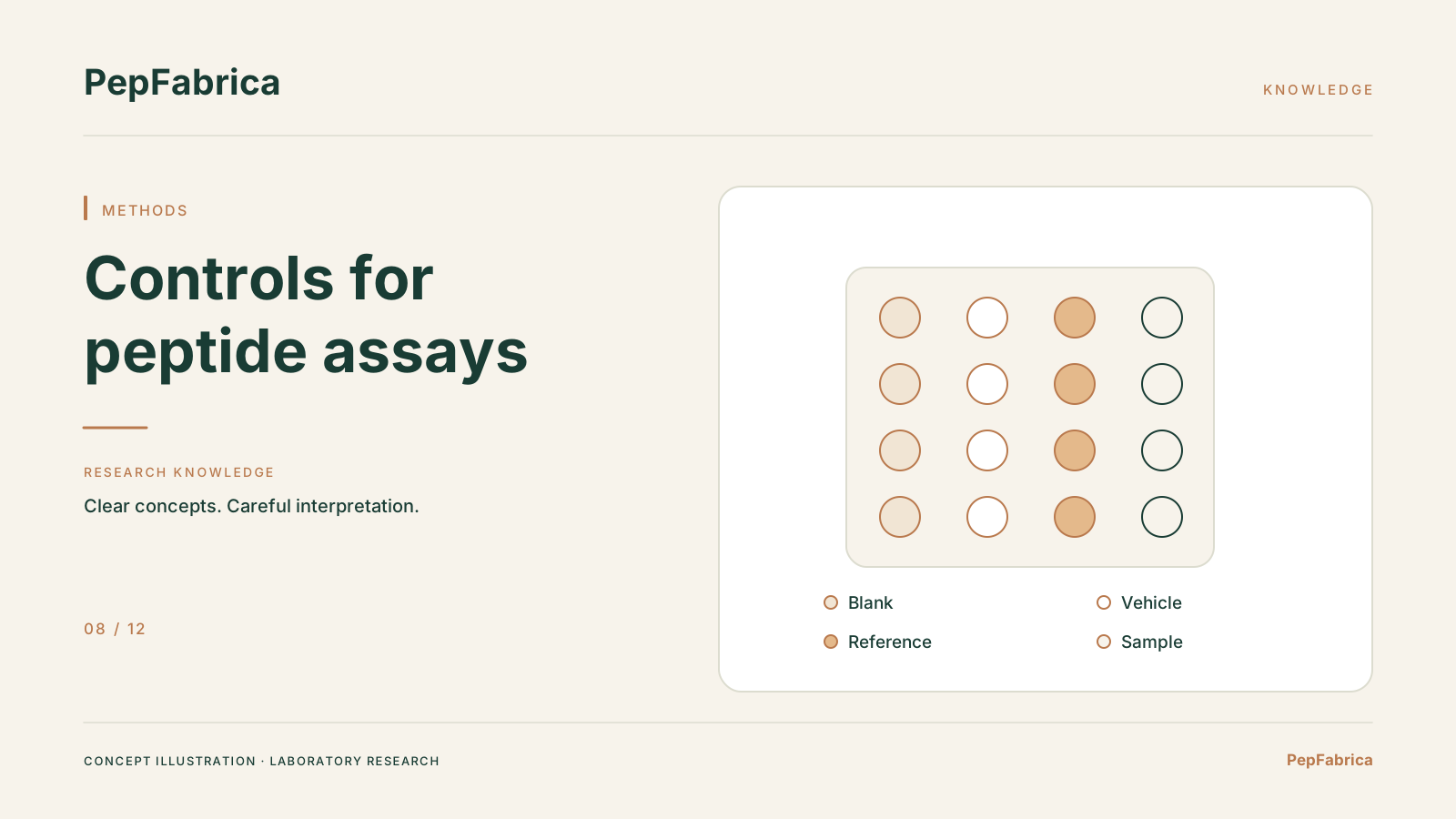
PepFabrica’s control map starts with the bench layout and the purpose of each comparison. Documenting that purpose early makes unexpected results easier to investigate.
Give each control a job
A control is useful because it addresses a specific alternative explanation. Depending on the method, examples may include background, vehicle, reference-response and detection-interference controls. The appropriate set must be chosen for the actual experimental system, rather than copied as a universal plate layout.
For each proposed control, write the question it addresses, the expected observation and the condition under which it would make the run difficult to interpret. Define these criteria before reviewing the test results.
Separate the biological system from the readout
An observed assay signal may reflect the detection method as well as the process being studied. The NIH Assay Guidance Manual provides extensive method-development background, including approaches for investigating interference. An orthogonal measurement uses a meaningfully different detection approach to examine a related question; repeating the same readout alone is not the same thing.
Build a compact run map
Record the preparation IDs, material lots, vehicle conditions, sample positions and planned controls. Distinguish technical replicates from independent experimental repeats. Preserve observations about failed or unexpected controls even when the run cannot support the original interpretation.
When a control fails, investigate the defined question rather than selecting only the test wells that look persuasive. Keep any follow-up analysis separate from the original plan so readers can distinguish planned comparisons from exploratory ones.
Frequently Asked Questions
Does a positive reference response prove a test material’s identity?
No. It helps evaluate part of the assay’s performance; chemical identity requires suitable analytical evidence.
Is repeating the same assay an orthogonal check?
Not necessarily. An orthogonal approach should provide a distinct source of evidence relevant to the suspected interference or mechanism.
Sources and further reading
Continue reading
- A Reporting Checklist for Concentration-Response Experiments
- From Bench Notes to a Reusable Research Record
For laboratory research use only. Not for human or animal use.